
Connectivity Architecture
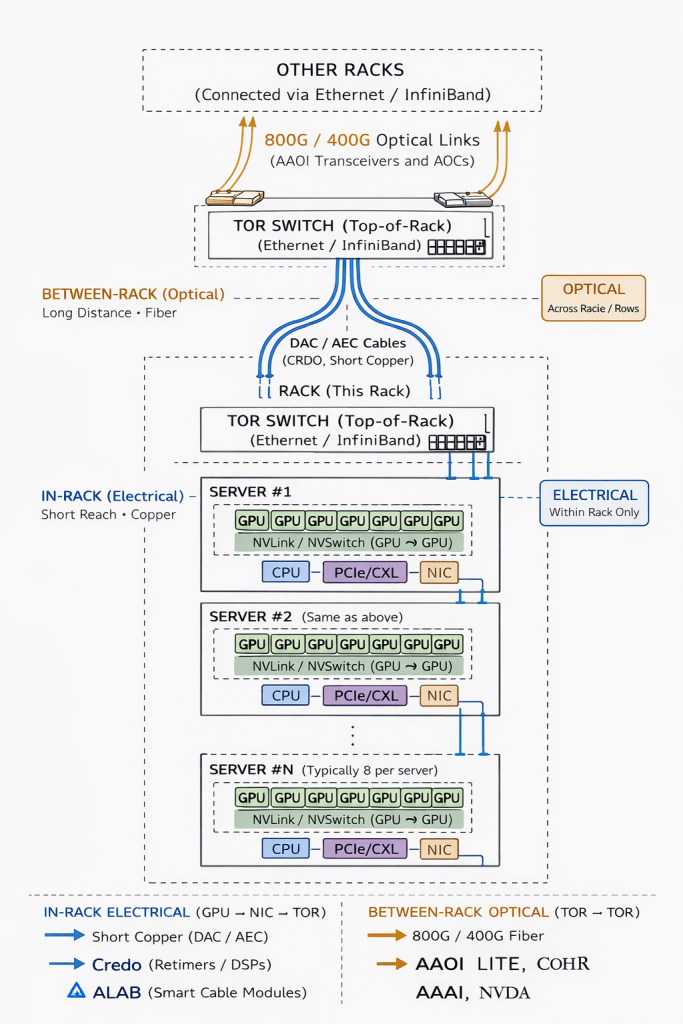
Inside a server / GPU box
- NVLink / NVSwitch (fast GPU fabric)
- PCIe / CXL (CPU ↔ GPU, GPU ↔ NIC, GPU ↔ SSD, memory pooling)
- Astera/CRDO retimers help extend these links.
Within a rack
Two paths exist:
a) Server-to-switch links (TOR switch)
Usually via:
- Short DAC (<3m)
- AECs (Credential DSP-based copper)
- Optics (AAOI)
These are still Ethernet, but only at the NIC edge — not for internal device communication.
b) GPU-to-GPU within the same tray/backplane
Via NVLink or PCIe.
Between racks
- Long-reach optics (AAOI) using 400G/800G QSFP-DD/OSFP
- Network fabric is Ethernet or InfiniBand
Retimers
Retimers are digital signal processing (DSP) chips used to:
- Clean up high-speed electrical signals
- Extend reach over copper inside servers (PCIe/CXL)
- Extend reach within the rack (as part of an AEC cable)
- Enable reliable connectivity at 100G / 200G per lane SerDes speeds
Retimers DO NOT replace optics and DO NOT replace AECs — they complement them.
Retimers appear in two places:
1️⃣ Inside an AEC Cable (Cable Retimers)
AEC = Active Electrical Cable
Retimers are embedded inside the cable ends.
They:
- Recover the signal (equalization + CTLE + DFE)
- Reclock the data
- Reduce bit errors
- Make copper work reliably at 400G / 800G / 1.6T
Without retimers, copper fails beyond ~1 meter at 100G/lane speeds.
This is why Credo is dominant:
- Credo makes the retimer/DSP silicon that OEMs insert inside AECs.
- Broadcom/Marvell also make DSPs, but Credo has merchant leadership.
- Cable vendors (Luxshare, Amphenol) use Credo chips inside their AECs.
If you buy a high-speed AEC, it almost certainly contains:
➡ Credo retimers or
➡ Marvell retimers or
➡ Broadcom retimers (captive)
So:
Retimers are the heart of AECs.
2️⃣ Inside Servers for PCIe / CXL Connectivity (System Retimers)
Used inside:
- GPU servers
- CPU motherboards
- NICs
- AI accelerator cards
- PCIe/CXL expansion boxes
These retimers (also called “redrivers + clock data recovery”) extend reach for:
PCIe 5.0 (32GT/s)
PCIe 6.0 (64GT/s)
CXL 2.0 / 3.0 memory expansion
This is the segment where Astera Labs (ALAB) is the market leader.
ALAB products:
- Aries PCIe retimers
- Leo CXL memory connectivity chips
Astera is not an AEC supplier — they do system-level retimers, not cable-level retimers.
The Three Types of Interconnect Silicon
| Layer | Technology | Key Vendors | Distance | Used For |
|---|---|---|---|---|
| 1. Copper Inside Rack | AEC DSP Retimers | Credo, Marvell | 1–5m | AEC cables inside a rack |
| 2. Copper Inside Server | PCIe/CXL Retimers | Astera, Broadcom | cm–1m | CPU–GPU–NIC signaling |
| 3. Optical Between Racks | Optical Transceivers | AAOI, Innolight, Coherent | 5–100m+ | Inter-rack AI networking |
Notice how each vendor sits in a different layer:
- Credo → AEC copper (retimers inside cables)
- Astera → PCIe/CXL inside server (system retimers)
- AAOI → Optical between racks
- Broadcom/Marvell → Both system PHYs + cable DSPs
They do not directly compete, except for Broadcom/Marvell who overlap everyone.
Putting It All Together in an AI Rack
Inside the GPU server:
Retimers (Astera, Broadcom)
→ Extend PCIe/CXL paths CPU ↔ GPU ↔ NIC
Inside the rack:
AECs (Credo DSP retimers inside cables)
→ Connect server NICs to TOR switches
Between racks:
Optical transceivers (AAOI)
→ Connect TOR to spine/superspine switches
→ Scale GPU clusters across racks
 Invest Alpha