
The Company
GE Vernova (ticker: GEV) is the energy-focused spin-off from General Electric that designs, manufactures and services the equipment and systems used to generate, transfer, convert and store electricity — including gas turbines and other power-generation equipment, onshore & offshore wind turbines, grid equipment (transformers, switchgear, HVDC) and electrification/energy-storage systems.
Financials
Bull Thesis
- GEV is the number one producer of gas turbines. There is a massive demand for these among utility companies as well as for onsite energy production to meet the uptick in energy requirement of AI datacenters.
- GEV also produces several electrification products such as transformers and switchgear. There is a US wide push to upgrade the grid infrastructure to meet the increased energy demands. GEV acquired Prolec in late 2025, a key producer of distribution transformers, that sets up as a key transformer manufacturer.
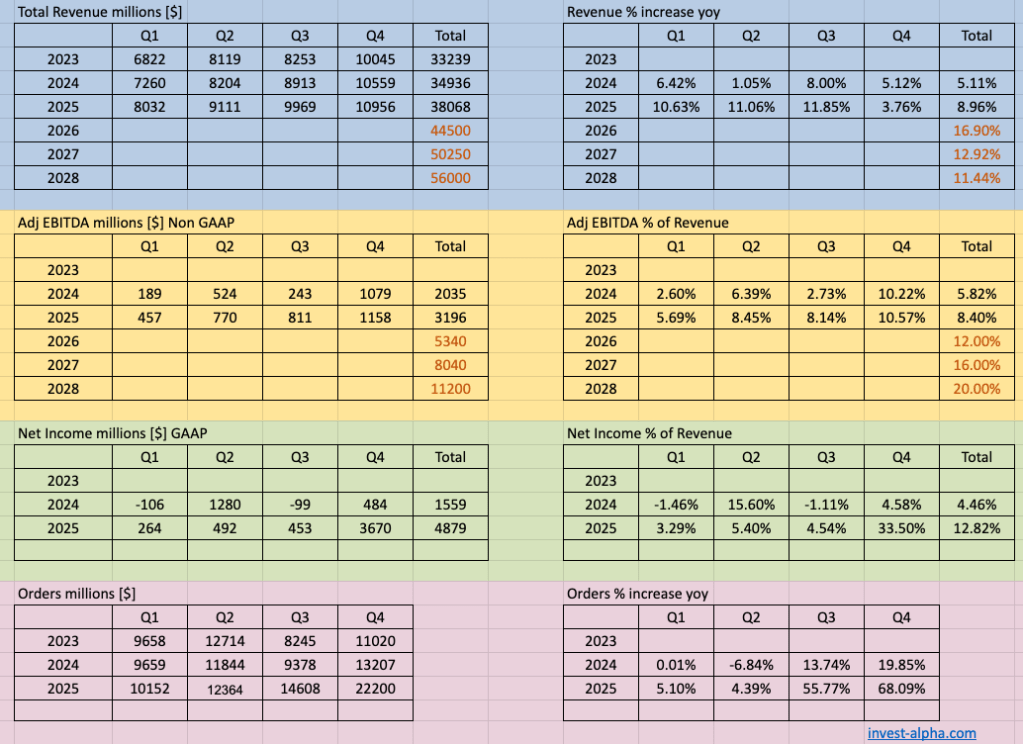
- Latest Q1 2026 orders grew 71% YOY to 18.3Bill$. Book to bill ratio is ~2X. Total backlog is now at 163Bill $ where the realized revenue for 2026 is expected to be 45 Bill$. Management now expects 200 Bill$ backlog in 2027, pulled in from 2028.
Management Outlook
- We saw continued strength in new gas turbine agreements in Q1, signing 21 gigawatts in countries like the U.S., Vietnam, Mexico, Brazil, and Canada to grow our total gigawatts under contract from 83 to 100 gigawatts sequentially
- On production capacity, we now have installed over 280 new machines in our Gas Power factories and remain on track to reach 20 gigawatts of annualized output by March.
2. Electrification may be the hidden gem
- Orders $7.1B (+86%)
- Data center orders $2.4B in Q1 alone
- More than all of FY2025 data center orders
- Backlog grew from $9B (2022) → $42B
Meaning:
GEV is becoming a major beneficiary of AI data center power/grid buildout.
3. Gas Power pricing power remains strong
- New 2026 turbine orders priced 10%–20% above Q4 2025
- 21 GW new agreements signed in Q1
- 100 GW now under contract
Meaning:
Turbine scarcity + urgent power demand = rising margins.
4. Guidance raised
2026 New Outlook:
- Revenue: $44.5B–$45.5B
- EBITDA Margin: 12%–14%
- Free Cash Flow: $6.5B–$7.5B
Meaning:
Higher confidence after strong start.
5. Free cash flow was massive
- $4.8B Q1 FCF
- More than all of FY2025 FCF ($3.7B)
Driven partly by customer down payments / slot reservations.
Meaning:
Customers are paying early to secure supply.
6. Wind still weak / drag on company
- Revenue down 25%
- EBITDA loss ($382M)
Still impacted by:
- weak onshore demand
- tariffs
- offshore contract losses
Meaning:
Wind remains the ugly duckling.
7. AI helps GEV two ways
AI as demand driver:
More data centers need:
- turbines
- transformers
- substations
- EMS/grid software
AI internally:
Using AI for:
- parts planning
- sourcing
- factory productivity
8. Prolec acquisition looks smart
Transformer business strengthened.
- $5B backlog
- 25% backlog growth since announced
Meaning:
Transforms GEV into stronger North American transformer supplier.
TAM / CAGR (market opportunity)
GE Vernova competes across several large electrification markets (power-generation equipment, electrical-grid equipment & HVDC, wind turbines and energy storage). A representative view of these adjacent markets: the global electrical grid market is in the low-hundreds of billions (~$268B in 2023) and is forecast to grow at mid-single-digit CAGRs into 2030; major submarkets such as HVDC and high-voltage equipment are growing at ~6–8% CAGR. Taken together, the combined addressable opportunity for GE Vernova’s product set is in the hundreds of billions of dollars with mid-single-digit to high-single-digit CAGR expectations over the next 5–10 years. (This reflects the sum of grid modernization, power-generation equipment and renewable equipment markets rather than a single consolidated “GE Vernova TAM”.)
Products
| Main Category | Sub Category | Products / Solutions | End Customers | Approx % of Total Revenue |
|---|---|---|---|---|
| Power | Gas Power Equipment | Heavy-duty gas turbines (HA, 7F, 9F), aeroderivative turbines | Utilities, IPPs, hyperscalers | 18% |
| Power | Gas Power Services | Maintenance, upgrades, outages, digital monitoring, long-term service agreements | Installed turbine base | 17% |
| Power | Steam / Nuclear Equipment | Steam turbines, generators, BWRX-300 SMR equipment, nuclear island systems | Nuclear utilities | 5% |
| Power | Nuclear Services | Refueling support, maintenance, uprates, parts | Nuclear fleet operators | 4% |
| Power | Hydro | Hydro turbines, generators, upgrades | Utilities, governments | 3% |
| Electrification | Transformers | Power transformers, medium-voltage transformers, Prolec products | Utilities, data centers, industrials | 10% |
| Electrification | Grid Systems Integration | HVDC systems, substations, EPC grid connection projects | Utilities, offshore wind, nations | 9% |
| Electrification | Switchgear / Protection | Switchgear, breakers, relays, capacitors | Utilities, industrial, campuses | 6% |
| Electrification | Power Conversion & Storage | UPS, battery systems, synchronous condensers, rotating machines | Data centers, industry | 5% |
| Electrification | Software / Automation | GridOS, GridBeats, EMS, monitoring, analytics | Utilities, hyperscalers | 3% |
| Wind | Onshore Wind Equipment | Wind turbines, nacelles, blades, towers integration | Utilities, developers | 8% |
| Wind | Onshore Wind Services | O&M, spare parts, performance upgrades | Installed fleet | 4% |
| Wind | Offshore Wind | Haliade-X turbines, offshore service, commissioning | Offshore developers | 5% |
| Corporate / Other | Financial / Other | Financing, legacy items, eliminations | Various | 3% |
GEV is the largest producer of gas trubines at 25% followed by Schneider at 24%.
Business Model
GE Vernova sells capital equipment (large, long-cycle orders for turbines, transformers, HVDC terminals and wind farms), after-market services (long-term service agreements, parts and maintenance), and increasingly software/automation for grid orchestration. Profitability depends on equipment volume and margin capture on large projects plus higher-margin recurring services and digital offerings. The company also pursues project-level deals and strategic partnerships (including co-development / site-delivery agreements) to place large-scale generation and grid projects. GE Vernova
Customers
Customers are utilities, independent power producers, major industrial users, developers of renewable projects and large hyperscale data-center / energy-intensive customers. Examples of customer use cases include utility grid upgrades (HVDC/substation projects), large gas-fired plants (including projects tied to data centers), and wind-farm developers for onshore/offshore turbines. The business has a mix of multi-year engineered equipment contracts and long-term service agreements. GE Vernova
Competitors (top 3 products that directly compete)
- Siemens Energy — competes across gas turbines, grid equipment (transformers, switchgear, HVDC solutions) and wind (via Siemens Gamesa/related units). Siemens is one of the closest full-scope rivals. Bloomberg
- Mitsubishi Power / Mitsubishi Heavy Industries — major competitor in large gas turbines and utility-scale generation equipment. Bloomberg
- Vestas / Other major wind OEMs (and Hitachi Energy for grid) — in wind turbines (Vestas, Siemens Gamesa) and in certain grid areas (Hitachi Energy competes in transformers, grid automation). Which of these is most relevant depends on the sub-market (wind vs. grid vs. gas). Global Energy Monitor+1
Founding History
GE Vernova was created when General Electric reorganized and spun off its energy businesses in 2024. The spin-out consolidated GE’s legacy energy units (power turbines, renewable energy, grid solutions and energy financial services) into a focused, publicly listed company (NYSE: GEV) aimed at leading electrification and the energy transition. The new company inherited GE’s long history and installed base in power and grid infrastructure while positioning itself as a specialist in decarbonizing electricity systems.

