
The Company
SanDisk is a leading provider of NAND flash memory storage solutions, supplying chips and storage products used in data centers, smartphones, PCs, automotive systems, and consumer devices. The company operates across both component (NAND chips) and end-product storage (SSDs, cards, USB) markets, making it a vertically integrated storage player.
Financials
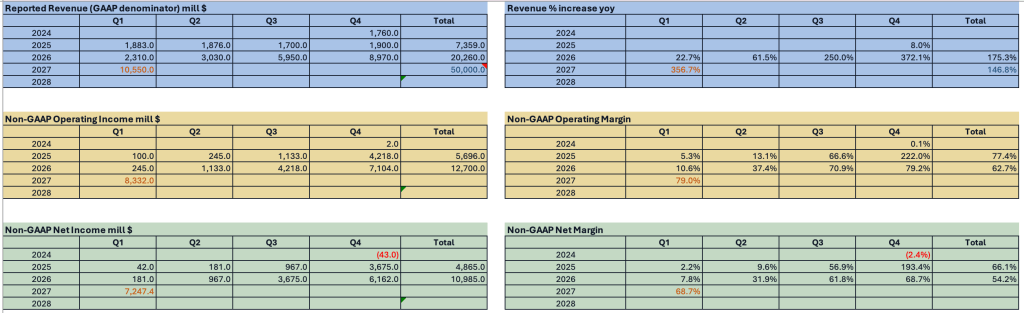
Bull Case for SNDK
- NAND cycle recovery → ASP expansion drives massive earnings leverage
- AI storage demand → inference + training require high-performance SSDs
- Mix shift toward enterprise SSDs (higher margin)
- Industry consolidation → improved pricing discipline
- Bit demand structurally growing faster than supply
Bear Case for SNDK
- NAND remains a commodity → pricing crashes recur
- Oversupply risk from competitors (Samsung, SK hynix)
- High capex → weak FCF in downturns
- Limited differentiation vs competitors
- AI upside may skew more toward compute (GPUs) than storage
Management Outlook (Q4 2026)
NBM –
- NBMs are quickly becoming our predominant way of doing business. We will continue supporting our non-NBM business with uncommitted supply.
- The length of our NBMs varies extending up to 5 years with a weighted average duration of over 4 years. We expect our NBMs to represent more than 50% of our bits in fiscal year 2027, and approximately 2/3 of our bits in fiscal year 2028.
- Since announcing 5 NBMs during our April earnings call, we have signed 5 additional agreements, 3 NBMs with new customers and 2 deals expanding on previously signed NBMs.
- The total expected revenue from all our NBMs we have signed is a minimum of $93.9 billion, assuming floor pricing.
- Each one of our NBMs include financial guarantees through a combination of cash deposits and financial instruments totaling $16.5 billion, which are intended to protect Sandisk if a customer fails to satisfy its purchase obligations under these agreements.
- Margins – we do expect to be around 80% for the new business models
Demand –
- Demand from our customers is growing faster than our supply. We, therefore, expect bits to remain on allocation beyond calendar year 2027.
Misc –
- The shift to inference in agentic AI is generating data at a scale that is redefining storage requirements. Every AI interaction creates content that must be stored, retrieved and served at low latency. And each of these steps relies on data storage products, including our high-capacity enterprise SSDs.
- We estimate that the NAND market will approach $500 billion in revenue in calendar year 2027.
TAM & CAGR – NAND Flash & Storage Market
- Sandisk estimates that the NAND market will reach 300 Bill$ in 2026 and $500 billion in calendar year 2027.
- Datacenter share of total TAM to expand from approximately 30% in calendar year 2025 to approximately 50% in calendar year 2026 and to continue outpacing the market in 2027
Growth Drivers:
- AI data center storage demand (training + inference)
- Hyperscaler SSD adoption
- Smartphone storage density growth
- Automotive storage (ADAS, edge AI)
- PC refresh cycles (higher storage per device)
Products
| Category | Products | Use Case | Approx % Revenue | Key Competitors |
|---|---|---|---|---|
| Client SSDs | NVMe SSDs (WD Black, Blue) | PCs, laptops | ~25–30% | Samsung, Micron |
| Data Center SSDs | Enterprise NVMe SSDs | Hyperscalers, AI storage | ~20–25% | Samsung, SK hynix |
| Mobile & Embedded NAND | UFS, eMMC | Smartphones, tablets | ~20–25% | Micron, Kioxia |
| Removable Storage | SD cards, microSD | Cameras, mobile | ~10–15% | Samsung, Kingston |
| USB & External Storage | USB drives, portable SSDs | Consumers, creators | ~10–15% | Seagate, Samsung |
| NAND Components (OEM) | Raw NAND wafers/dies | OEM integrations | ~10–15% | Micron, SK hynix |
Nand Flash is the primary storage medium used in Sandisk’s SSDs.
Business Model
- Vertically integrated NAND manufacturer
- Revenue streams:
- NAND component sales (commodity exposure)
- Branded storage products (higher margin)
- Long-term supply agreements with OEMs & hyperscalers
- Capital intensive → requires continuous node shrink investment
Economic Model:
- Revenue = (Bits shipped × ASP per bit)
- Profit = Highly sensitive to NAND pricing cycles
Customers
- Hyperscalers (cloud + AI workloads)
- Smartphone OEMs
- PC OEMs (Dell, HP, Lenovo)
- Automotive suppliers (ADAS storage)
- Consumers (retail storage products)
Competitors
1. Samsung Electronics
- Market leader in NAND
- Strongest in enterprise SSD + vertical integration
2. Micron Technology
- Competes in NAND + DRAM
- Strong presence in data center SSD + mobile
3. SK hynix
- Growing NAND share (via Solidigm acquisition)
- Strong in enterprise SSDs for hyperscalers
Founding History
- Founded in 1988 by Eli Harari, Sanjay Mehrotra, and Jack Yuan
- Pioneer of flash memory storage technology
- Acquired by Western Digital in 2016
- Recently repositioned / separated to focus on pure-play NAND & flash storage
 Invest Alpha