
The Company
Datadog is a cloud-native observability and security platform that helps companies monitor, analyze, and optimize their applications, infrastructure, and logs in real time. It sits on top of cloud environments (AWS, Azure, GCP) and provides a unified view of system performance, reliability, and security.
Financials
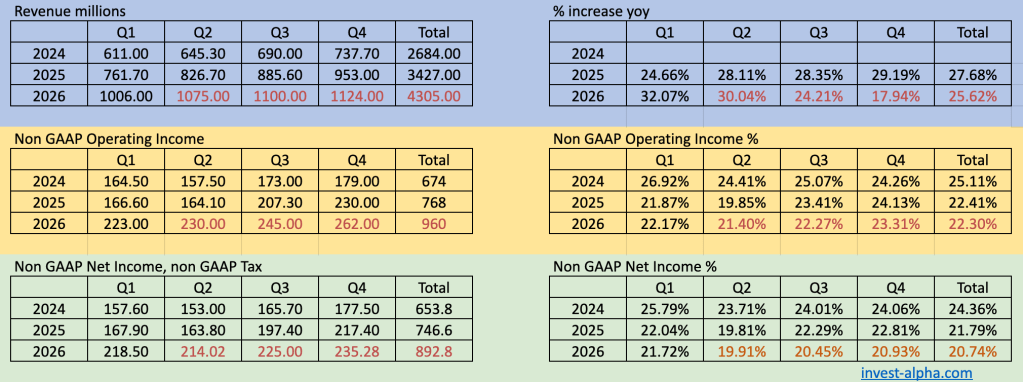
Bull Case
- Datadog is a platform agnostic infrastructure monitoring and analysis tool that gives you a single dashboard to monitor cloud applications in production.
- Although Cloud Infrastructure providers, different software applications include AI LLMs provide their own telemetry and logging for analysis, the space is extremely fragmented. Datadog abstracts all of this into a single unified dashboard irrespective of the platform in use.
- While Cloud migration of applications has been the main driver of revenue for Datadog, AI workloads are becoming a second secular growth story for them. AI complexity is expected to increase the requirement for observability due to it’s distributed, GPU heavy and latency sensitive characteristics.
- Datadog has high gross margins and is a very profitable business. They offer a usage based pricing model for customers. Revenue growth rates have been very steady at ~30%.
- Mission critical platform with high switching costs as seen by their high customer retention rates.
- Multiproduct expansion flywheel – Customers typically start with infra monitoring → expand into logs, APM, security, RUM, etc.
Bear Case
1. Growth deceleration
- From 60% → ~20%
- Could re-rate as a “mature SaaS”
2. Cloud providers competition
- Amazon Web Services (CloudWatch)
- Microsoft Azure (Monitor)
- Google Cloud Platform (Operations Suite)
→ cheaper, bundled alternatives
3. Tool consolidation trend
Enterprises trying to reduce vendors → fewer point solutions.
4. AI abstraction risk (your earlier question)
If users interact via AI agents:
- fewer traditional app touchpoints
- less telemetry? (debatable)
5. Usage-based volatility
Revenue tied to:
- logs ingested
- infra usage
→ can decline in optimization cycles
Management Outlook
- we also continue to see very high growth within these AI-native customer groups as they go into production and grow in users, tokens, and new products.
- We signed 18 deals over $10 million in TCV this quarter, of which two were over $100 million, and one was an 8-figure land with a leading AI model company.
- We think many of the largest enterprises are still very early in their journey to the cloud. The median Datadog ARR for our Fortune 500 customers is still less than half a million dollars, which leaves a very large opportunity for us to grow with these customers
- We continue to see strong growth dynamics with our core three pillars of observability: infrastructure monitoring, APM, and log management. with these three pillars, we are still just getting started, as about half of our customers do not buy all three pillars from us, or at least not yet.
- infrastructure monitoring contributes over $1.6 billion in ARR. log management is now over $1 billion in ARR. This includes continued rapid growth with FlexLogs, which is nearing $100 million in ARR. And our third pillar, the end-to-end suite of APM and DEM products, also crossed $1 billion in ARR. This includes an acceleration of our core APM product, into the mid-thirties percent year over year, currently our fastest-growing core pillar.
- We are executing relentlessly on a very ambitious AI roadmap, and I will split our AI efforts into two buckets: AI for Datadog and Datadog for AI
- We launched the AI SRE agent for general availability in December to accelerate root cause analysis and incident response. Over 2,000 trial and paying customers have run investigations in the past month
- Datadog for AI. This includes capabilities that deliver end-to-end observability and security across the AI stack. We are seeing an acceleration in growth. Over 1,000 customers are using the product, and the number of fans sent has increased 10 times over the last six months.
- land deals with 2 of the world’s biggest AI research teams, helping them improve and optimize their training workflows.
- nearly 5% of AI model requests failing in production and close to 60% of those failures caused by capacity limits.
TAM / CAGR — Market Opportunity
- Estimated TAM: $60–70B+ (observability + security convergence)
- Expected CAGR: 12–18%
Breakdown:
- Infrastructure Monitoring
- Application Performance Monitoring (APM)
- Log Management
- Security / SIEM
- AI Observability (emerging)
Key shift:
Observability + Security + AI telemetry → converging into one platform
Products
| Product Category | Description | % Revenue (Est.) | Key Competitors |
|---|---|---|---|
| Infrastructure Monitoring | Metrics across servers, cloud, containers | ~25% | Dynatrace, New Relic |
| APM (Application Performance Monitoring) | Tracks app latency, errors, traces | ~20% | Dynatrace, New Relic |
| Log Management | Centralized logging + analytics | ~20% | Splunk |
| Security (Cloud SIEM, CSPM, etc.) | Threat detection, compliance | ~10–15% | Splunk, CrowdStrike |
| Real User Monitoring (RUM) | Tracks end-user experience | ~5–10% | Dynatrace |
| Synthetic Monitoring | Simulated testing of apps | ~5% | New Relic |
| Network Monitoring | Tracks network performance | ~5% | Cisco tools |
| Database Monitoring | DB performance insights | ~5% | Oracle tools |
| AI / LLM Observability | Monitoring AI models, prompts, latency | Emerging | New Relic, startups |
AI Products
AI for Datadog
AI products and capabilities that make the Datadog product itself better.
- With MCP Server, developers access live production data to debug their applications directly in their AI coding agent or IDE. We delivered this AI security agent, which autonomously triages Datadog Cloud SIEM signals, conduct in-depth investigations of potential threats, and delivers actionable recommendations
- AI security agent, which autonomously triages Datadog Cloud SIEM signals, conduct in-depth investigations of potential threats, and delivers actionable recommendations.
- Bit Assistant now in Preview, which helps customers search and act across Datadog using natural language
Datadog for AI
Datadog for AI that includes capabilities that deliver end-to-end observability and security across the AI stack.
- We launched GPU monitoring, enabling teams to understand GPU fleet utilization, workload efficiency, thermal and power behavior and interconnect performance. This drives higher GPU ROI and operational reliability
DeepAI DevAgent, which detects code-level issues, generates fixes with production context, and can even help release the monitor fix.
BigAI security, which autonomously charges SIEM signals, conducts investigations, and delivers recommendations.
Launched GPU Monitoring for generally availability, to help businesses optimize spend and performance as they scale AI projects—providing unified visibility across GPU fleet health, cost, and performance linked directly to the teams and workloads consuming those resources, enabling faster troubleshooting and cost savings.
Business Model
- SaaS subscription + usage-based pricing
- Charges based on:
- Hosts monitored
- Logs ingested
- Traces analyzed
Land → Expand model:
- Start small (infra monitoring)
- Expand into:
- logs
- APM
- security
→ drives ARPU growth
Customers
Typical users:
- Cloud-native companies
- Enterprises migrating to cloud
Examples:
- Shopify
- Samsung
- Peloton
- Goldman Sachs
Use case:
Engineering teams use Datadog to:
- detect outages
- debug issues
- optimize performance
Competitors — Top 3 Direct Competitors
1. Dynatrace
- Strongest direct competitor
- Deep AI-driven observability
- Strong enterprise penetration
2. New Relic
- Similar product suite
- More developer-focused
- Pricing disruption strategy
3. Splunk
- Leader in log analytics & SIEM
- Strong security positioning
- Less cloud-native historically
Founding History
- Founded: 2010
- Founders: Olivier Pomel (CEO), Alexis Lê-Quôc (CTO)
- IPO: 2019
Origin:
- Built to solve cloud monitoring complexity as AWS adoption increased
- Early focus: infrastructure metrics
- Expanded into full observability platform over time

