
The Company
Snowflake is a cloud-native AI data platform company that enables enterprises to store, process, analyze, share, and build AI applications on top of large-scale structured and unstructured data across multiple public clouds including AWS, Azure, and Google Cloud. Snowflake’s core value proposition is separating compute from storage, enabling customers to scale workloads independently while paying on a consumption basis. Over the past two years, the company has increasingly repositioned itself from a cloud data warehouse provider into an “AI Data Cloud” platform focused on enterprise AI, data engineering, data sharing, and AI agents.
Snowflake (SNOW) Financials and Growth Analysis
| Metric | FY2024 | FY2025 | FY2026 |
|---|---|---|---|
| Revenue | ~$2.8B | ~$3.6B | ~$4.7B |
| Product Revenue Growth | ~38% | ~30% | ~29-30% |
| Gross Margin | ~75-76% | ~76% | ~75-76% |
| Non-GAAP Operating Margin | ~6% | ~6-9% | ~9% |
| Net Revenue Retention | ~131% | ~126% | ~126% |
| Remaining Performance Obligations (RPO) | ~$5.2B | ~$6.9B | ~$9.2B+ |
| $1M+ Customers | ~455 | ~580 | ~779 |
| Forbes Global 2000 Customers | ~590 | ~745 | ~813 |
Recent Quarter Highlights (Latest Reported)
| Metric | Q1 FY2027 |
|---|---|
| Revenue | ~$1.39B |
| Product Revenue Growth | ~34% YoY |
| Adjusted EPS | $0.39 |
| Guidance Raised | Yes |
| FY2027 Product Revenue Guidance | ~$5.84B |
| Q2 Product Revenue Guidance | ~$1.42B |
Snowflake delivered one of its strongest quarters since going public, with accelerating AI-driven demand, stronger enterprise consumption trends, and a major expanded partnership with AWS involving approximately $6B in cloud infrastructure commitments over five years.
Snowflake (SNOW) Bull Case Investment Thesis
1. Snowflake Is Becoming the Enterprise AI Data Layer
The largest challenge in enterprise AI is not model availability — it is governed enterprise data access. Snowflake sits directly at this intersection.
Its platform increasingly acts as:
- The enterprise data warehouse
- The data governance layer
- The AI orchestration layer
- The inference and vector database layer
- The enterprise AI application layer
This positioning could make Snowflake one of the core beneficiaries of enterprise AI adoption.
2. Consumption Model Creates Strong Operating Leverage
Snowflake’s usage-based pricing model benefits when customers:
- Store more data
- Run more queries
- Train more AI models
- Execute more inference workloads
- Deploy AI agents
AI workloads are compute intensive and data intensive, which structurally increases consumption.
3. Massive Expansion Opportunity Beyond Data Warehousing
Snowflake has expanded into:
- AI/LLM inference
- Vector search
- Data engineering
- Cybersecurity analytics
- Observability
- Application hosting
- AI agents
- Marketplace monetization
This significantly enlarges its TAM beyond traditional analytics.
4. Strong Competitive Position with Multi-Cloud Neutrality
Unlike AWS Redshift, BigQuery, or Microsoft Fabric, Snowflake operates across all major clouds.
This neutrality is attractive to large enterprises that do not want vendor lock-in.
5. AI Products Are Accelerating Growth Again
Recent launches include:
- Cortex AI
- Snowflake Intelligence
- Cortex Agents
- Document AI
- Cortex Search
- Snowpark
- AI Observability tools
Management increasingly positions Snowflake as a platform for enterprise AI application development rather than merely a database vendor.
Snowflake (SNOW) Bear Case Investment Risks
1. Databricks Is Becoming a Serious Threat
Databricks is arguably Snowflake’s biggest competitive risk.
Databricks has:
- Strong AI-native developer mindshare
- Deep integration with Apache Spark
- ML-first architecture
- Open-source credibility
- Strong momentum in AI model training pipelines
Many enterprises increasingly evaluate Databricks and Snowflake together.
2. Hyperscalers Could Compress Margins
AWS, Azure, and Google Cloud all compete with Snowflake:
- AWS Redshift
- Google BigQuery
- Microsoft Fabric/Synapse
Because Snowflake depends on hyperscaler infrastructure, cloud providers maintain structural leverage over Snowflake economics.
3. Consumption Revenue Can Become Cyclical
Snowflake’s business model is usage-based.
If enterprises optimize workloads or reduce cloud spending:
- Revenue growth can decelerate quickly
- Net revenue retention can fall sharply
This occurred during prior enterprise optimization cycles.
4. AI Monetization May Take Longer Than Investors Expect
The market increasingly values Snowflake as an AI platform.
If enterprise AI deployments:
- Move slowly
- Remain experimental
- Fail to scale economically
then Snowflake’s premium valuation may become difficult to justify.
5. Open Table Format Movement Is a Threat
Open-source table formats like:
- Apache Iceberg
- Delta Lake
- Parquet ecosystems
reduce proprietary lock-in advantages.
The industry is increasingly moving toward interoperable data architectures.
Snowflake (SNOW) Management Outlook
Main Highlights from Snowflake Q1 FY2027 Earnings
1. Massive Revenue Re-Acceleration
Very strong quarter.
| Metric | Result |
|---|---|
| Product Revenue | $1.334B |
| YoY Growth | 34% |
| Prior Quarter Growth | 30% |
| Full-Year Guide Raised | 27% → 31% |
Management repeatedly emphasized:
- AI demand accelerated materially
- CoCo was the biggest driver of upside
- Core business ALSO accelerated simultaneously
This is important because investors feared Snowflake’s core warehouse business was maturing.
Instead:
- core accelerated
- AI layered on top
- margins improved simultaneously
That combination is rare.
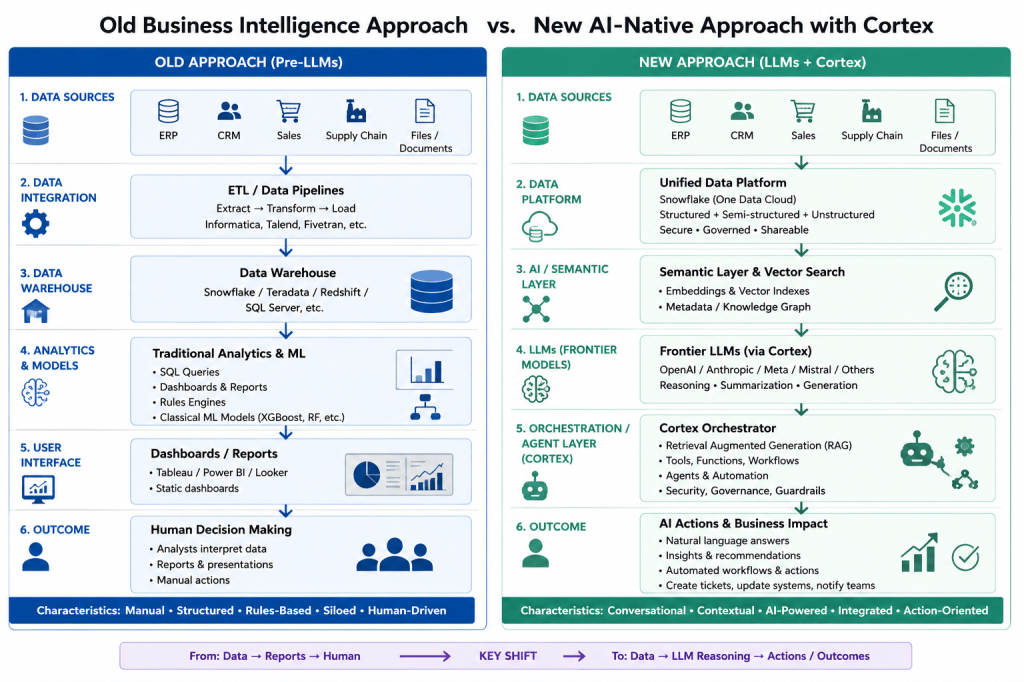
2. CoCo Became the Main Story
Snowflake’s AI coding/agent platform:
- Cortex Code (“CoCo”)
Management effectively said:
CoCo materially changed the company trajectory.
Key stats:
- 7,100+ active accounts already
- fastest product adoption in Snowflake history
- “largest driver” of forecast increase
The important part:
CoCo is NOT just standalone AI revenue.
It increases:
- migrations
- pipeline creation
- app development
- agent creation
- data workloads
Meaning:
AI products increase core Snowflake consumption.
That is the “AI flywheel” management kept discussing.
3. AI Is Now Material Revenue
This was probably the most important line financially:
Brian Robins:
“Snowflake’s AI workload is now a significant revenue engine in its own right.”
That is a major shift.
Previously:
- AI was mostly “future narrative”
Now:
- management is explicitly attributing meaningful revenue acceleration to AI products
That is why the stock reacted so strongly.
4. AWS Deal Was Huge
The new:
- 5-year
- $6B AWS agreement
was one of the biggest strategic announcements.
Key implications:
- Snowflake expects enormous AI workload growth
- AWS is heavily backing Snowflake
- bandwidth/networking costs decline
- helps preserve margins despite expensive AI inference
Management explicitly said:
- lower AWS bandwidth costs offset AI margin pressure
Very important because investors feared AI inference would crush software margins.
5. Margins Improved Despite AI
Usually:
- rapid AI growth hurts margins
Instead:
| Metric | Result |
|---|---|
| Non-GAAP Operating Margin | 12% |
| YoY Expansion | +300bps |
| FY27 Operating Margin Guide | Raised to 13.5% |
| Product Gross Margin Guide | Maintained at 75% |
This was a major surprise.
Why?
Because AI workloads are expensive.
Snowflake offset it through:
- AWS infrastructure efficiencies
- disciplined hiring
- internal AI productivity gains
6. Hiring Slowed Dramatically
Very interesting operational detail.
They added:
- only 17 organic employees in the quarter
Most hiring came from acquisitions.
Management basically said:
AI tools are making engineers + sales + support dramatically more productive.
Examples:
- support resolution times ↓ 25%
- engineering productivity doubled in some teams
- more use cases per account executive ↑ 86%
This is one of the clearest examples yet of a large software company claiming real internal AI productivity gains.
7. Agentic AI Is Becoming the Company Narrative
Snowflake is repositioning itself from:
- “cloud data warehouse”
toward:
- “agentic enterprise control plane”
Their thesis:
Snowflake becomes the governed system where:
- enterprise data
- AI models
- workflows
- applications
- agents
all connect together.
Management repeatedly used phrases like:
- “agentic control plane”
- “intent becomes action”
- “business users and intelligent agents”
This is now central to the company strategy.
8. Natoma Acquisition Matters More Than It Looks
Natoma lets agents:
- send emails
- open Jira tickets
- summarize Slack
- interact with workflows/apps
This pushes Snowflake beyond analytics into:
- enterprise workflow automation
In other words:
they are trying to evolve toward:
- AI operating layer for enterprises
not just a data platform.
9. Strong Customer Expansion
Healthy enterprise demand.
| Metric | Result |
|---|---|
| Total Customers | 13,912 |
| Net New Adds | +616 |
| Growth in New Customers | +38% YoY |
| Customers >$10M TTM Spend | 64 |
| Customers >$1M Spend | 79 |
Importantly:
large enterprise customers accelerated too.
Not just SMB AI experimentation.
10. The Key Debate Going Forward
The bull case:
- Snowflake becomes core AI infrastructure layer for enterprises
- AI agents massively increase consumption
- CoCo drives platform expansion
- margins hold up better than feared
The bear case:
- AI inference costs eventually compress margins
- hyperscalers/databricks compete harder
- AI spend normalization slows consumption
- CoCo enthusiasm cools after initial adoption wave
But this quarter strongly strengthened the bull narrative.
Overall Read
This was probably:
- Snowflake’s most important earnings call since IPO.
Why?
Because the company showed:
- Core business acceleration
- Real AI monetization
- Margin expansion
- Massive hyperscaler partnership validation
- Strong enterprise adoption
- AI products becoming meaningful revenue drivers
Snowflake (SNOW) TAM / CAGR Opportunity
| Market | Estimated TAM | Expected CAGR |
|---|---|---|
| Cloud Data Analytics | ~$150B+ | ~20-25% |
| AI Data Platforms | ~$250B+ | ~25-35% |
| Data Warehousing | ~$70B+ | ~15-20% |
| Enterprise AI Software | ~$500B+ long term | ~30%+ |
| Data Engineering & Lakehouse | ~$100B+ | ~20% |
Snowflake increasingly competes across multiple software categories simultaneously, which expands its long-term opportunity substantially beyond its original data warehouse market.
Snowflake (SNOW) Products and Revenue Breakdown
| Product / Service | Description | Approx % Revenue | Main Competitors |
|---|---|---|---|
| Data Warehousing | Core cloud-native analytics database platform | ~40% | Databricks, Redshift, BigQuery |
| Data Lake / Lakehouse | Unified structured & unstructured data platform | ~15% | Databricks, Microsoft Fabric |
| Data Engineering | ETL, pipelines, transformation workloads | ~10% | Databricks, Informatica |
| AI & ML Platform (Cortex AI) | LLM inference, vector search, AI agents | ~10% | Databricks Mosaic AI, AWS Bedrock |
| Data Sharing & Marketplace | Cross-company governed data sharing | ~8% | Databricks Delta Sharing |
| Snowpark Developer Platform | Python/Java/Scala app development | ~5% | Databricks notebooks |
| Security / Governance | Data governance and compliance tooling | ~5% | Collibra, Alation |
| Observability / Monitoring | AI & data observability tools | ~2% | Datadog, Monte Carlo |
| Professional Services | Consulting & implementation | ~5% | Internal enterprise teams |
Snowflake’s largest revenue driver remains compute consumption tied to analytics and query execution.
AI workloads are becoming an increasingly important incremental driver.
Cortex AI
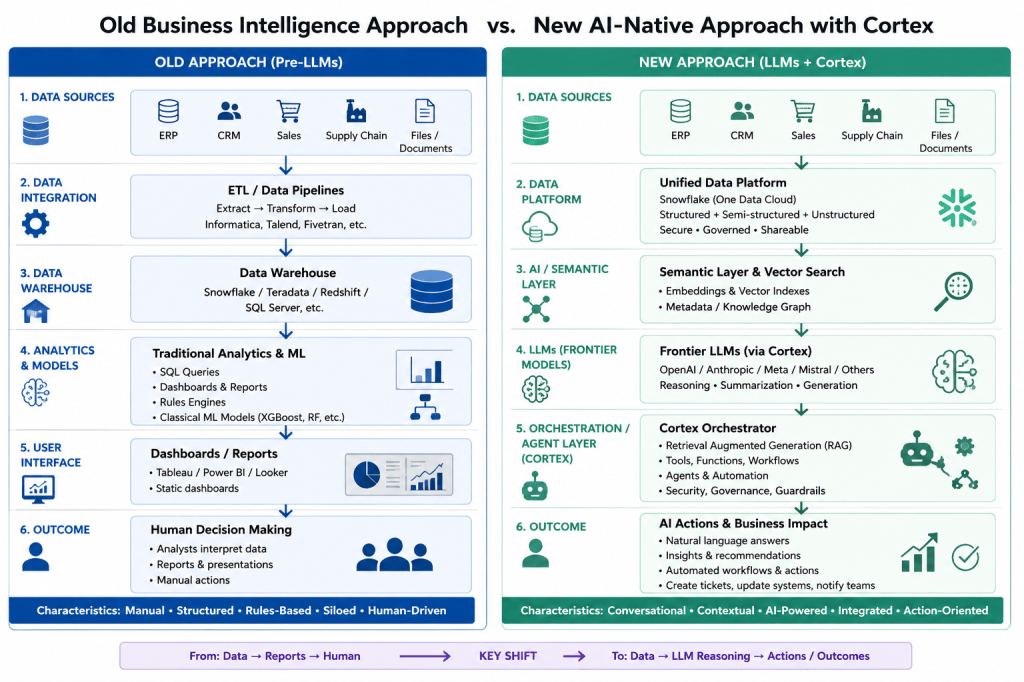
Snowflake (SNOW) Business Model Explained
Snowflake operates a consumption-based SaaS model.
Customers purchase:
- Compute credits
- Storage
- Data transfer capacity
- AI inference workloads
Key characteristics:
- Multi-cloud deployment
- Highly scalable architecture
- Usage-driven monetization
- Land-and-expand strategy
- Very high gross margins
- Strong net revenue retention
Unlike traditional SaaS companies with seat-based pricing, Snowflake monetizes customer usage growth over time.
This creates:
- Strong upside during expansion cycles
- Higher volatility during optimization cycles
Snowflake (SNOW) Enterprise Customers and Industry Exposure
Snowflake serves thousands of enterprises globally.
Key customer categories:
- Financial services
- Retail
- Healthcare
- Manufacturing
- Technology
- Media
- Government
Large enterprise adoption is particularly strong among Fortune 500 companies.
Notable ecosystem integrations include:
- AWS
- Microsoft Azure
- Google Cloud
- NVIDIA AI ecosystems
- OpenAI
- Anthropic
The company has hundreds of customers generating over $1M annually in product revenue.
Which departments specifically use Snowflake’s products :
| Customer Type | What They Use Snowflake For |
|---|---|
| Data Engineering Teams | Building data pipelines, ETL, centralizing company data |
| Data Analysts / BI Teams | Dashboards, SQL analytics, reporting |
| AI / ML Teams | Training data prep, vector search, inference pipelines |
| Application Developers | Building data apps and AI agents using Snowpark/Cortex |
| Business Operations Teams | Finance, marketing, supply chain analytics |
| IT / Data Platform Teams | Governance, security, data sharing |
Snowflake (SNOW) Top Competitors Analysis
| Competitor | Competing Products | Key Strength |
|---|---|---|
| Databricks | Lakehouse, AI/ML platform, Mosaic AI | AI-native architecture and strong developer adoption |
| Amazon Web Services | Redshift, Athena, Bedrock | Integrated hyperscaler ecosystem |
| Microsoft | Fabric, Synapse, Azure AI | Deep enterprise distribution and Office ecosystem |
Additional competitors:
- Google BigQuery
- Oracle Autonomous Database
- Teradata
- MongoDB Atlas
- Cloudera
The competitive battle is increasingly shifting from:
“Who owns the data warehouse?”
to
“Who becomes the enterprise AI operating layer?”
Snowflake (SNOW) Founding History and Evolution
Snowflake was founded in 2012 by:
- Benoît Dageville
- Thierry Cruanes
- Marcin Żukowski
The founders previously worked on database technologies at Oracle.
The original vision:
- Build a cloud-native data warehouse from scratch
- Separate compute from storage
- Eliminate traditional on-prem database limitations
Major milestones:
- Initially launched on AWS
- Expanded to Azure and Google Cloud
- IPO in 2020 in one of the largest software IPOs ever
- Frank Slootman aggressively scaled enterprise sales execution
- Sridhar Ramaswamy took over as CEO in 2024 to accelerate AI strategy
Snowflake has since evolved from:
Cloud Data Warehouse → Data Cloud → AI Data Cloud platform.

