
The Architecture of a Modern AI Agent
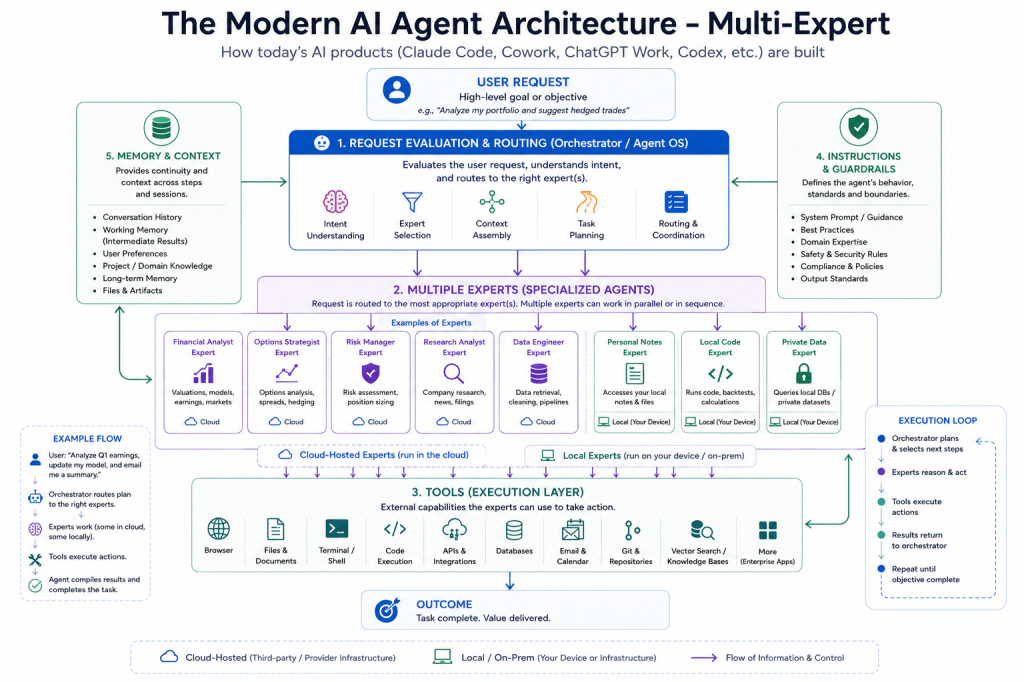
The Five Core Components
| Component | Role |
|---|---|
| Orchestrator | The “operating system” of the AI agent. It receives the user’s request, creates and manages the execution plan, maintains workflow state, schedules tasks, handles retries, coordinates tool usage, and determines when the objective has been completed. |
| Large Language Model (LLM) | The reasoning engine. It interprets the current task, decides which tool to use next, analyzes results, writes content, generates code, and helps refine the execution plan when needed. |
| Tools | External capabilities available to the agent, including browsers, terminals, file systems, code execution environments, APIs, databases, email, calendars, and enterprise applications. |
| Instructions | Product-specific guidance that defines the agent’s behavior, including system prompts, best practices, safety policies, coding standards, and domain expertise. |
| Memory & Context | The working memory of the agent, including conversation history, intermediate results, project files, user preferences, and long-term context that enables complex, multi-step tasks. |
How an AI Agent Works
Unlike a traditional chatbot that generates a single response, an AI agent continuously cycles through reasoning and action until the task is complete.
A simplified execution loop looks like this:
- The user submits a high-level objective.
- The orchestrator creates an execution plan and initializes the workflow.
- The orchestrator sends the current task to the LLM.
- The LLM decides whether to reason further or invoke a tool.
- The selected tool executes and returns its results.
- The orchestrator updates the workflow state and determines the next step.
- If new information changes the situation, the orchestrator asks the LLM to revise the plan.
- The cycle repeats until the orchestrator determines that the objective has been successfully completed.
This continuous Plan → Reason → Act → Observe → Re-plan loop is what differentiates an AI agent from a traditional conversational chatbot.
Different Products Are Different Configurations
Most leading AI products share the same architectural foundation but specialize by exposing different tools, instructions, and workflows.
| Product | Primary User | Specialized Tools | Primary Optimization |
|---|---|---|---|
| ChatGPT | General users | Search, documents, images | Conversational AI and knowledge work |
| ChatGPT Work | Knowledge workers | Browser, office documents, presentations, coding tools | End-to-end business workflows |
| Codex | Software developers | Terminal, Git, IDE, testing, repositories | Software engineering |
| Claude | General users | Search, documents | Conversation and analysis |
| Claude Cowork | Knowledge workers | Browser, files, spreadsheets, office workflows | Autonomous office productivity |
| Claude Code | Software developers | Terminal, Git, IDE, shell, debugging | End-to-end software development |
| Gemini | General users | Google Workspace | Productivity and search |
| Gemini Code Assist | Software developers | IDE, repositories, Google Cloud | Enterprise software development |
| GitHub Copilot | Software developers | IDE integration, repositories | Developer productivity |

