

The Company
TransMedics is a medical technology company that specializes in organ transplant solutions, with its primary focus on improving organ preservation, transportation, and transplantation. The company has developed the Organ Care System (OCS), an innovative platform designed to maintain organs in a near-living state outside the human body. This technology aims to improve the quality, availability, and success rates of organ transplants.
Financials

TAM / CAGR
TAM expected to grow to $1 billion at a CAGR of 8% to 10% from 2023 to 2030. This growth is driven by:
- Rising Organ Transplant Demand: As populations age and chronic diseases like heart and liver failure become more prevalent, the demand for organ transplants continues to increase.
- Technological Advancements: New preservation methods, such as warm perfusion (e.g., TransMedics’ OCS), have improved organ viability and increased the number of successful transplants.
- Improved Donation Rates: Public awareness campaigns and improvements in healthcare infrastructure are boosting organ donation rates globally.
- Regulatory Approvals: Approvals by regulatory bodies like the U.S. FDA for systems like the OCS Heart, Lung, and Liver are accelerating market growth.
Products
- OCS Lung
- OCS Heart
- OCS Liver
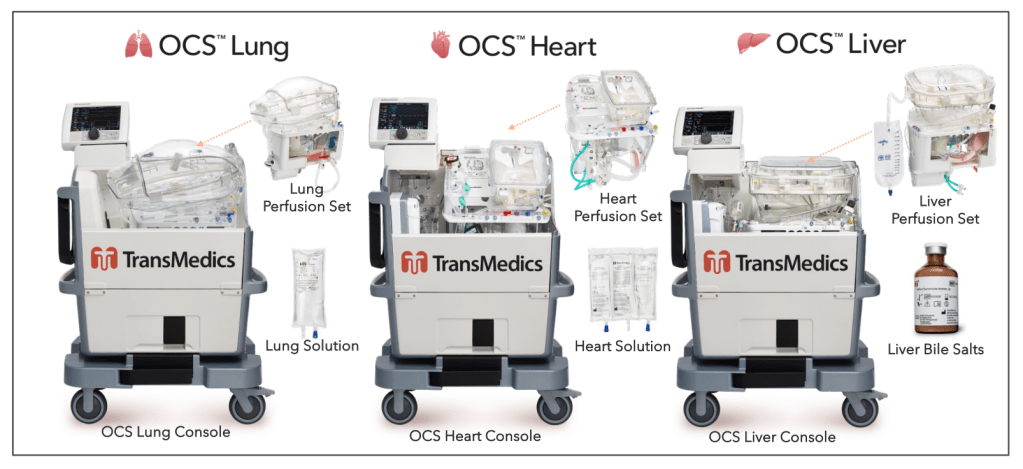
Business Model
1. Capital Equipment + Disposable Consumables (Razor-Razorblade Model)
- Organ Care System (OCS) consoles are sold or leased to transplant centers.
- For each transplant, centers must purchase single-use perfusion kits and organ-specific solutions. This ensures recurring revenue from each transplant procedure.
2. OCS Program Services (Organ Retrieval + Logistics + Coordination)
- TransMedics offers a full-service model called the National OCS Program, which includes:
- Deploying trained TransMedics perfusion staff to donor hospitals.
- Managing the OCS device, organ perfusion, and data during transport.
- Coordinating air and ground logistics from donor site to recipient hospital.
- This is a turnkey organ retrieval and delivery service, typically billed as part of the transplant operation.
3. Hospital & Transplant Center Contracts
- Transplant centers contract with TransMedics to procure and utilize OCS for heart, lung, and liver transplants.
- Hospitals may purchase:
- Just the OCS devices and disposables, or
- Subscribe to full OCS Program Services.
Who Pays?
1. Transplant Centers / Hospitals
- The primary customer is the transplant hospital, which pays for:
- The OCS platform and disposables.
- The service fee for end-to-end organ retrieval and delivery.
2. Private Insurance / Medicare / Medicaid
- Transplant procedures in the U.S. are covered by:
- Medicare/Medicaid (especially for kidney transplants).
- Private insurers for those with coverage.
- The OCS costs are typically bundled into the transplant DRG (diagnosis-related group) reimbursement, which covers all transplant-related expenses.
- Hospitals may absorb the upfront costs but recover them through reimbursement.
3. Organ Procurement Organizations (OPOs) [Sometimes]
- In rare or specialized cases, an OPO may pay for transportation when coordinating organ recovery.
- However, OPOs generally just coordinate and do not directly pay for OCS services—those are billed to the transplant center receiving the organ.
Example Workflow
- Donor organ becomes available.
- TransMedics dispatches an OCS team to retrieve and perfuse the organ.
- OCS unit keeps the organ alive and monitored during transport.
- Organ arrives at transplant center, where it is implanted.
- TransMedics invoices the hospital for:
- OCS disposable kit
- Use of OCS device (lease or amortized cost)
- Transport and staffing services (if OCS Program used)
Revenue Streams
| Revenue Source | Description |
|---|---|
| OCS Console Sales / Leasing | Upfront or periodic payment by transplant centers |
| Disposable Kits (Heart, Lung, Liver) | High-margin, required per use |
| OCS Program Services | End-to-end organ transport (staff, logistics, care) |
| Service Contracts / Maintenance | For installed OCS units |
Competitors
XVIVO Perfusion, Paragonix Technologies, OrganOx, Bridge to Life Ltd, Lifeline Scientific, Organ Recovery Systems, Waters Medical Systems
TransMedics’ warm perfusion technology allows organs to function outside the body by mimicking the natural environment, while many competitors rely on traditional cold storage methods. However, companies like OrganOx and XVIVO also use perfusion-based systems, creating direct competition in the liver, lung, and heart transplant markets.
Bear Thesis
- Any validity to the concerns raised by the Scorpion Capital Short Report. https://scorpionreports.s3.us-east-2.amazonaws.com/TMDX.pdf
- The competitive moat around the OCS Perfusion Technology. Is this technology very difficult to replicate ?
- The company owns its own fleet of aircraft after the acquisition of Summit Aviation in August 2023 and is in the process of building out the fleet. Operating costs for maintaining aviation fleet is significant.
- Long term concerns around the increasing availability and use of artifical organs. Artificial organs for humans (like hearts or lungs) are still in early research stages.
Earnings Call Highlights – Q2 2025
- Received conditional Investigations Device Exemption (IDE) approval from the U.S. Food and Drug Administration
to initiate the Next-Gen OCS™ Lung trial - Close to achieving similar approval for Next-Gen OCS Heart trials.
- Both these should be growth drivers in 2026.
- Targeting 10000 NOP Transplants in the US by 2028.
- Exploring expanding NOP services to Europe which will double TAM.
- Operating own fleet of 21 aircraft.
 Invest Alpha